
Thug life
More than a political crisis, we face a moral one

Candidly, I don’t have anything to say that isn’t already being said elsewhere, often more eloquently or more viscerally personal. But now is one of those rare instances when I think just saying something publicly does have value, for at least two reasons:
The cheap, personal rationale: I don’t want to be asked by my kid years from now why, as “state terror” emerged, I seemingly retreated into a selfish life—posting sunnily on Instagram about trendy coffeeshops and blandly on LinkedIn about work milestones while the world crumbled.12
More importantly: The thuggish ethos of the second Trump administration, unconstrained neither by laws nor morality, has only gotten more brazen insomuch as their transgressions draw only segmented outrage.
In kidnapping Nicolas Maduro, for example, they could count on the unpopularity of Venezuela’s dictator to make him unsympathetic for many to defend.3 Or, in threatening criminal charges against the Federal Reserve chairman Jerome Powell, they (at least initially) could count on the investor class’s hunger for lower interest rates.4
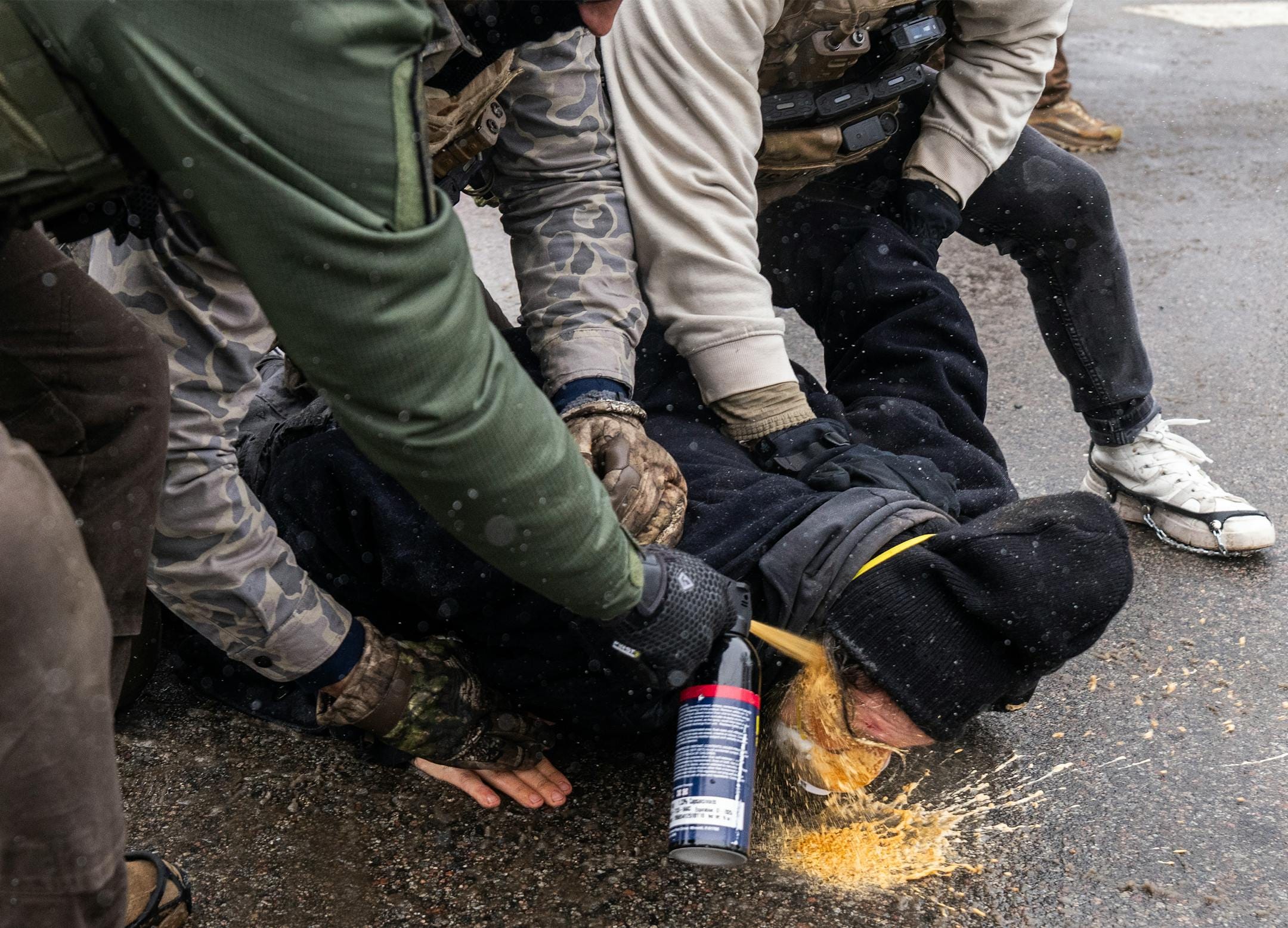
Neither of those incidents had the capacity to hit home for most Americans, though, like what’s going on in Minneapolis: the daily and well-documented onslaught of warrantless house searches, car window smashings, crowd-control grenades, inhumane treatment of the elderly and children alike, and most especially, the twin murders committed this month by masked, trigger-happy ICE (gunning for the moniker “Innocent Civilians Executed”) and Border Patrol agents.5
Renee Good and Alex Pretti, it has to be said, were white American citizens. Precisely because they were two ordinary, relatable 37-year-olds—a mother of three, an intensive-care nurse—there has been a desperate attempt by the administration to smear them. But ample video evidence has obliterated the shameless attempts to paint Good and Pretti as homicidal threats.6
Every indication has been that the Trump White House prioritizes flexing raw power over efficiently carrying out policy.7 But even if you’re in favor of strong immigration enforcement and border security, events on the ground should clearly indicate to you that this has been an untenable, counterproductive approach. Knowing that a line needs to exist matters deeply, because the alternative is an unaccountable paramilitary force that can do whatever it wants.
A heartening contrast is the example of Joseph H. Thompson, who until recently was the Trump-appointed acting U.S. attorney for Minnesota. Previously, he had overseen investigations into real, widespread, massive fraud in state-run programs related to pandemic relief, Medicaid, and housing assistance. An unfortunate truth about that fraud is that many of the perpetrators were from the state’s Somali immigrant community. But he stood firm against any further perversion of the law. Pressed by Pam Bondi’s DOJ after the shooting of Renee Good to launch a criminal investigation into Good’s wife, Thompson resigned—along with five other federal prosecutors in Minnesota. Their resistance mattered.
This month has felt like a year and it still isn’t over. I haven’t even mentioned last week’s saga of Trump demanding to annex Greenland. Amidst that drama, Canadian PM Mark Carney drew plaudits from the crowd that pays attention to Davos for saying, with unusual frankness for a Western leader:
“Stop invoking rules-based international order as though it still functions as advertised. Call it what it is—a system of intensifying great power rivalry, where the most powerful pursue their interests, using economic integration as coercion.”
Carney was acknowledging that the U.S., China, and Russia, notably, are acting unconstrained by traditional norms, and that they will do whatever they think they can get away with. He was referring to how they interact with other countries economically. I’d add the same is true for how they interact with other countries militarily, and also for how they handle domestic matters. In all of these cases, it’s not a traditional political issue we face, but a moral test—what lines do we draw for ourselves when no one else can enforce them?
I still firmly believe it's not too late for the U.S., and the world, to chart a different course. (Carney was right, too, to call on “middle powers” to “build something bigger, better, stronger, more just”.) Trump abruptly backed down from his Greenland saber-rattling in the face of surprisingly unified and forceful opposition from across Europe, including the threat of serious trade retaliation, as well as several notable Republican lawmakers joining Democrats to oppose the move.
Even as I’ve been writing this newsletter over the past ~24 hours, the administration shows signs of softening in the face of widespread pushback: Democrats have rallied to demand a freeze to ICE funding this week or force a government shutdown; prominent Republicans want answers, too; the CEOs of major Minnesota-based companies are calling for “deescalation of tensions” (mild, but I choose to view it as progress). The Times is now reporting that Trump is trying to “mend fences” with MN Gov. Walz, and he has sacked Gregory Bovino, who has led the on-the-ground Border Patrol operations there.
It may be hard to see in our present moment, but in the fight against authoritarian impunity, every bit of friction they encounter makes a difference. The outcome they want—a world where crudeness, coercion, and “what are you gonna do about it?” replace decency, accountability, and the rule of law—is only inevitable if we don’t all resist.
I don’t believe in rejecting joy, though. “Don’t let the bastards get you down.” Our burden to carry in these times is to neither succumb to hopelessness nor escapism.
Not breaking news here, y’all, this is a hypothetical future kid! 😅
Never mind that this unilateral surprise had nothing to do with democracy (the man who tried to steal our 2020 election left in place the regime that stole Venezuela’s last election) nor drugs (a month earlier Trump pardoned Juan Orlando Hernandez, former president of Honduras, recently convicted of trafficking hundreds of tons of cocaine into the US).
Instead of the stock market crashing the day after the announcement, the S&P 500 set an all-time high. Anything for a 50bps cut, right? 🙄 Only later, as figures ranging from JPMorgan CEO Jamie Dimon to Republican Sen. John Kennedy voiced their opposition, has the threat seemed to recede.
How quickly things have changed. Back in March 2025, when I first saw the video of masked men grabbing Tufts student Rumeysa Ozturk in broad daylight on a Massachusetts street, I was in disbelief that any lawful government agents would operate like that. Now it’s standard operating procedure.
How bad did you fuck up when even the NRA is like, uh, hold up a minute...?
The insecurity to ever admit they’ve made a mistake, no matter how small, was mildly amusing when Sean Spicer insisted Trump’s “covfefe” wasn’t a typo. When lives hang in the balance, it’s a tragedy.
Really appreciate how you coalesce the (seemingly endless onslaught) of news stories into a poignant narrative here. Bonus points for “Don’t let the bastards get you down" - Illegitimi non carborundum was a common saying in my home growing up!