
Foul play
Many NBA teams don't actually want to win games

This week, my hometown Washington Wizards clinched the dubious feat of becoming the first NBA team to ever lose at least 64 games in three consecutive seasons. Alas, basketball as humiliation ritual is nothing new for us Wizards fans—over the last 20 years, only the Sacramento Kings have a lower winning percentage. Not even winning a quarter of their games is supposed to be impossible for an ostensibly professional team playing in the most competitive league in the world.
If the Wizards were trying to win, it might well be impossible. Yet, owing to a unique set of circumstances with basketball roster construction, in the past several years it has become increasingly appealing for a number of teams, not just the Wizards, to intentionally be uncompetitive for a season—or even multiple seasons.
Known as “tanking,” teams will deliberately restrict the minutes played by better players, avoid signing good players, blatantly overstate the extent of player “injuries,” and shuffle through a rotating series of journeymen on their rosters. They do this to improve their lottery odds in the annual draft of new prospects, in which teams with worse records have a better chance of an early selection slot for new, inexpensive young talent entering the league.
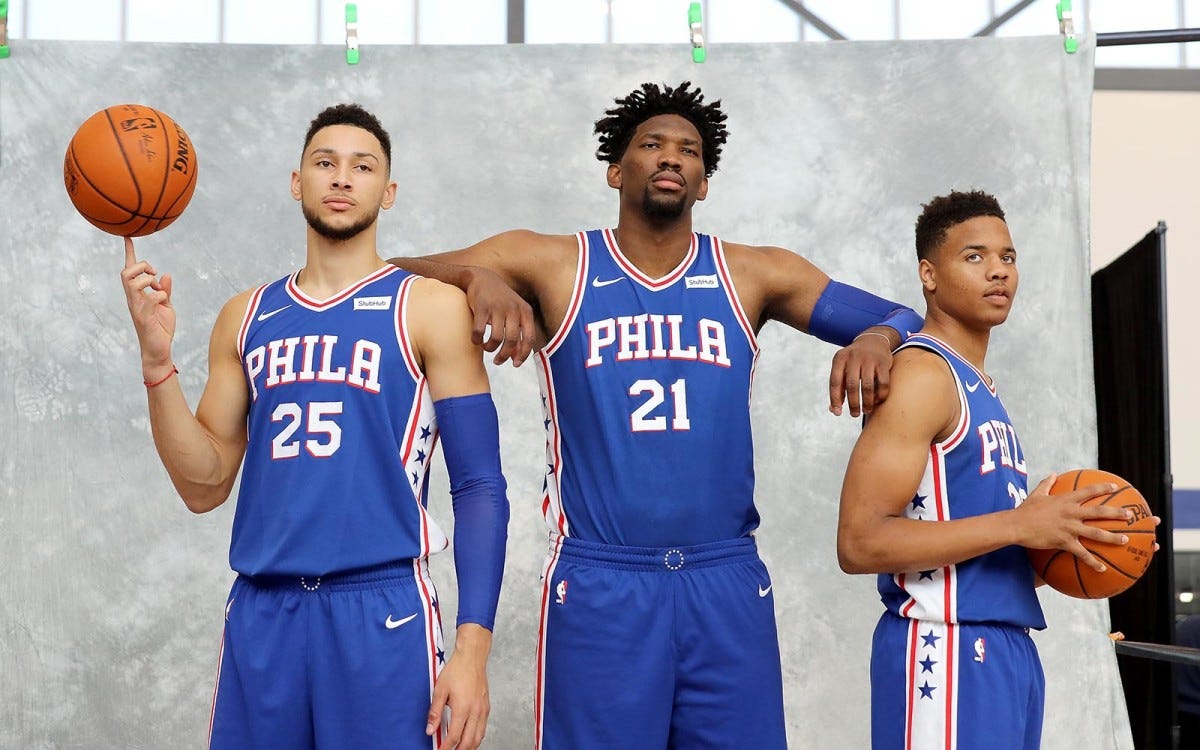
In 2019, the NBA made changes to the draft rules, “flattening” the lottery odds, and giving an equal chance at the top selection to the three worst teams. It hasn’t been nearly enough to dissuade teams from racing to the bottom. 2026 has seen more tank maneuvering than in the Battle of Kursk! Eight teams failed to win even a third of their games, and 10 of them finished double-digit games behind the lowest playoff (play-in) spot…
Fans of long-suffering teams in other leagues, such as the Pittsburgh Pirates or Cleveland Browns, have long moaned about their seeming unwillingness to be competitive. So what makes the NBA’s tanking problem uniquely worse?
One man game-changers
Far more so than in the other major American sports, a single basketball player can have much more of an outsized impact. There are only five players per team on the court at a time, playing both offense and defense.1
Compare that to football's 22 starters across offense and defense, or baseball's ultra-specialization of nine hitters, five starting pitchers who each only play one out of five games, and a half-dozen bullpen pitchers. No single baseball player can drag a team to the title.2 In the NFL, only a superlative QB can do that, and each draft class may contain one or two of those guys at most.
In basketball, one transcendent player (as we've seen with LeBron's Cavaliers, Kawhi's Raptors, Giannis’ Bucks, and Jokic's Nuggets) makes all the difference, and several can be found in each year's draft.3
League economic systems drive incentives
Why baseball is different
MLB, like capitalism run amok, has no salary cap (nor a floor). Thus, it suffers from a seismic gap between the haves and the have-nots. Perennial low spenders like the Pirates, Rockies, Athletics, and Marlins, and (in this decade) my Nationals skimp with payrolls of ~$100 million. Meanwhile, a handful of teams buy up stars on enormous contracts, notably the Dodgers, Mets, Yankees, and Phillies, each of whom have payrolls of ~$300 million and higher.4
But baseball teams largely lack the motivation to tank for a high draft pick. In 2021, MLB’s draft was halved to “only” 20 rounds, which means still over 600 prospects are selected. They typically take years to reach the majors, and there are few “sure things”. Meanwhile, the NBA draft has just two rounds, hence only 60 players, and talented rookies make an impact in their very first season.
Simply put, MLB teams don’t tank for strategic reasons, they tank because their owners are cheapskates who prioritize larger profits over winning.
Why football is different
In what is already a relatively short regular season (17 games), NFL players don’t sit out games merely to rest, unlike with the slog of an NBA campaign (82 games) or MLB season (162 games). So if and when you see tanking in football, it’s typically among just 2-3 teams during the last 2-3 weeks of the season, depending on if a highly-touted QB prospect will be available in the upcoming draft.
It’s also worth noting that the NFL is the only major sports league that doesn’t have guaranteed contracts. Players can, are often are, cut by their teams at any time, for any reason! In a job with structural job insecurity, combined with a much higher injury risk than any other sport, players are incentivized to play their hardest—whether for the good of their team, or to showcase themselves for their inevitable next job opportunity.
Don’t let tanking spoil a good thing
The NBA has had an excellent past two decades. It has overcome the fan malaise of the post-Jordan era, and has mostly shed the (unfair, racist) connotations that were often slung at its black player base.5 The game has exploded globally, and where international stars like Dirk Nowitzki were once rare exceptions, today no one blinks at the many European faces of the league (Doncic, Jokic, Wemby, Giannis, Embiid).6 Lastly, while the NFL seems to have survived the growing outrage from a handful of years back about concussions, basketball is still aligned long-term as the “safer” sport to play.
There are only two major concerns that could derail the NBA at this point: The first, as I’ve previously covered, is from its (over)involvement with sports betting. This problem is shared by every American sports league, and I think will only worsen. The other is widespread tanking, which alienates fans and diminishes their interest. Long-term this could lead to declining attendance, and then more seriously for the league, lower the value of TV broadcast rights.
Next month, the league will vote on one of three anti-tanking proposals:
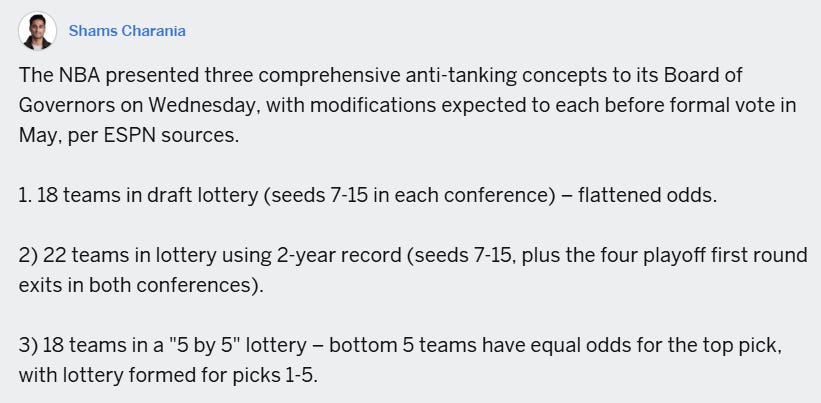
Of these, it seems like first (expanding the lottery to 18 teams, with the bottom 10 teams all having the same odds) would be the easiest to implement (and understand). The second system, whereby weighting is done across two seasons, seems like it would be harder for fans to track—although, the WNBA already does this. And I worry this would only further convince teams like my Wizards to intentionally suck for multiple years!
The third system, bracketing five teams at a time with equivalent odds, would probably be the most effective. Yes, it creates a new tanking threshold (between being the fifth-worst and sixth-worst team in the league)… but it would eliminate the need for extreme tanking, and ensures that the five worst teams do get access to a top five pick.
I hope any of the above plans are approved, and implemented ASAP.
Well, defense is optional if you’re Luka Doncic or James Harden, hehe.
Much to the chagrin of the Anaheim Angels, who squandered having not one, but two, guys who were fairly labeled “the greatest player of their generation”: Mike Trout and Shohei Ohtani.
Cade Cunningham and Victor Wembanyama are the most recent one-man transformers with legit title chances already.
Payroll disparity isn’t a huge issue in the NBA, which does have a salary floor. This year, each team’s payroll falls between $150 million and $215 million.
Younger NBA fans probably can’t imagine that there was an enormously controversial dress code implemented in 2005 to ban hip-hop style attire and accessories. Meanwhile, I bet David Stern could never have imagined that player ‘fits would become a routine, hugely popular fashion showcase every game day.
Heck, the reigning (and soon likely 2x) MVP is, gasp, Canadian. (And yes, Embiid is now a naturalized American citizen.)
Timely post. Some games definitely seem like weird "bye weeks" for competitive teams. I don't know why anyone would want to see Jazz/Kings in April, it's not like baseball where they bring up young prospects.
I still don't understand option 3. Can any team from 7 seed down still win the #1 pick (but the worst five teams get best odds)? Or do the worst five teams get assured picks 1-5? If the latter, I don't think that's an effective anti tank strategy.